

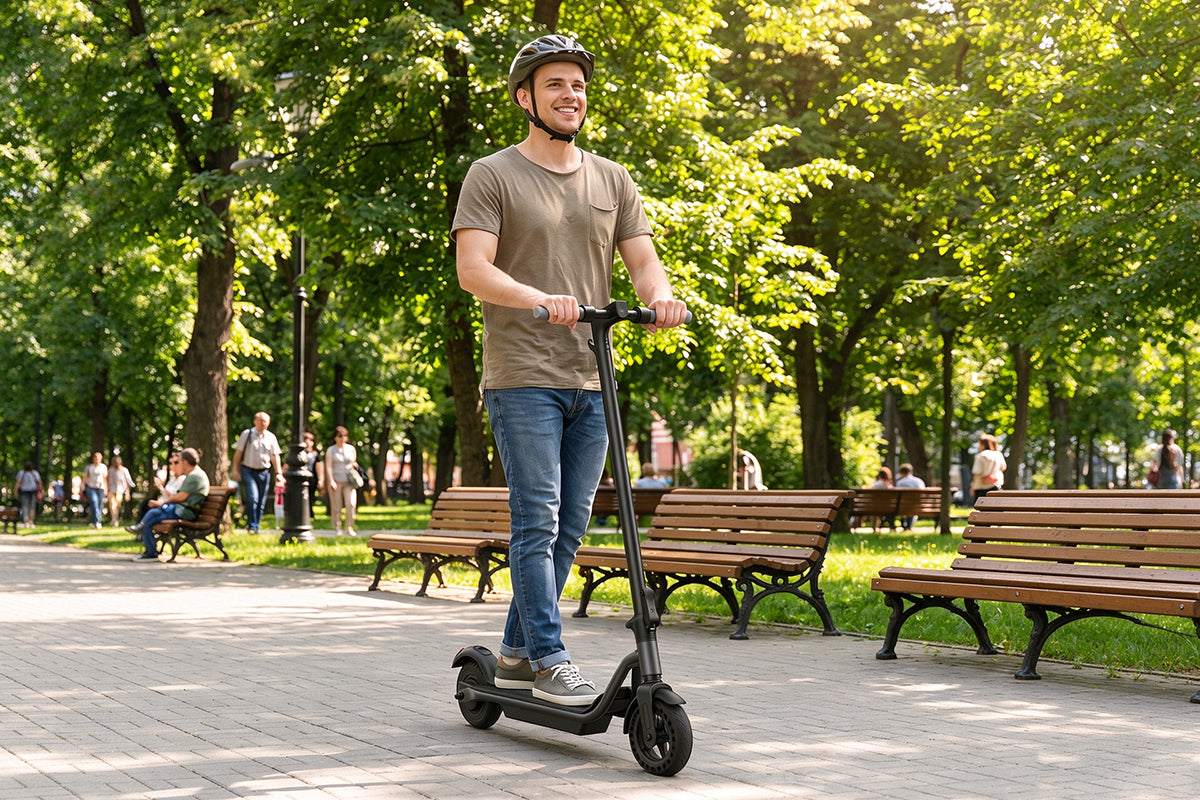
Choosing a long range electric scooter can make daily travel more convenient, flexible, and cost-effective. Whether you commute to work, ride to college, run errands, or connect with public transportation, a scooter with enough battery capacity can help you spend less time worrying about charging and more time getting where you need to go.
However, a scooter advertised with a 40-mile range does not necessarily travel 40 miles in everyday conditions. Rider weight, speed, hills, temperature, tire pressure, and riding style can all affect battery performance.
So, how do you choose the right long range electric scooter for daily travel? The key is to look beyond the advertised mileage and evaluate real-world range, battery capacity, comfort, safety, charging convenience, and total ownership cost.
1. Understand What Long Range Really Means
Range is usually the first specification buyers compare, but advertised range and real-world range are not always the same.
Manufacturers typically test scooters under specific conditions. Actual results may vary depending on the rider, terrain, weather, and speed. Riding at a higher speed generally consumes more energy, while frequent acceleration and steep climbs can reduce efficiency.
For daily commuting, a useful starting point is to choose a scooter with an advertised range approximately 1.3 to 1.5 times your expected daily riding distance. This is a practical planning guideline, not a guarantee of actual performance.
For example, if your round-trip commute is 12 miles, a scooter advertised for 16–18 miles may leave limited room for unexpected detours or unfavorable conditions. A model advertised for approximately 20–25 miles or more gives you a more comfortable starting point, although its real-world range still needs to be considered.
Here is a simple comparison:
| Daily round-trip distance | Suggested advertised range |
|---|---|
| 5–8 miles | 10–12 miles |
| 8–12 miles | 15–20 miles |
| 12–18 miles | 20–30 miles |
| 18–25 miles | 30–40 miles |
| 25+ miles | 40+ miles |
These are general shopping guidelines rather than performance guarantees. If your route includes steep hills, cold weather, or frequent high-speed riding, consider a larger margin.
The most important question is not simply, "How far can this scooter go?" It is, "Can this scooter reliably complete my regular trip without requiring inconvenient charging?"
2. Check Battery Capacity, Not Just Advertised Mileage
The battery is one of the most important components of a long range electric scooter. It determines how much energy the scooter can store and how much flexibility you have between charges.
Battery capacity is usually measured in watt-hours (Wh). If a manufacturer lists voltage and amp-hours but does not provide watt-hours, you can estimate capacity using this formula:
Watt-hours (Wh) = Voltage (V) × Amp-hours (Ah)
For example, a 48V battery rated at 15Ah has a nominal capacity of:
48V × 15Ah = 720Wh
A 720Wh battery stores more energy than a 48V, 10Ah battery, which has a nominal capacity of 480Wh. All else being equal, the larger battery generally offers greater range potential.
However, battery size alone does not determine distance. Motor efficiency, controller settings, scooter weight, tires, and aerodynamics also affect energy consumption.
When comparing electric scooters, look for:
- Battery capacity: Compare watt-hours when the information is available.
- Battery quality: Check the manufacturer's battery specifications, warranty, and safety documentation.
- Charging time: Make sure the charging schedule fits your routine.
- Battery replacement: Confirm whether replacement batteries are available and what they cost.
A larger battery may add weight and increase the purchase price. For riders who travel long distances every day, that trade-off may be worthwhile. For shorter urban trips, a smaller battery could offer a better balance of portability and performance.
3. Choose a Scooter That Matches Your Commute
The best long range electric scooter depends on where and how you ride. A comfortable scooter for suburban roads may not be the most practical option for a city commuter who carries it onto a train.
If your trip is mostly on paved streets and protected bike lanes, prioritize maneuverability, reliable brakes, lights, and a folding design. A moderate-range scooter may be sufficient, especially if you can recharge at home.
For trips exceeding 10 miles round trip, pay closer attention to battery capacity, sustained riding comfort, tire quality, and braking performance. A larger deck, stable geometry, and a well-designed suspension system can make longer rides more comfortable.
For hilly routes
Hills demand more power from the motor and can reduce range. Compare motor specifications, hill-climbing guidance, and the manufacturer's performance claims under load. Do not assume that a high peak-wattage figure guarantees strong sustained climbing performance.
For mixed transportation
If you plan to combine scooter rides with buses or trains, weight and folding dimensions become particularly important. A scooter with excellent range but excessive weight may be inconvenient to carry up stairs or into an office.
Before buying, map your actual route. Measure the round-trip distance, identify steep sections, and consider where you can safely park and charge the scooter.
4. Consider Motor Power, Speed, and Riding Efficiency
Battery capacity determines how much energy a scooter can store, while the motor and control system influence how efficiently that energy is used.
When comparing motor specifications, distinguish between rated power and peak power. Rated power describes the motor's sustained output under specified conditions, while peak power refers to a higher output available for a limited period. Peak power can be useful for acceleration and climbing, but it does not automatically mean better range.
For daily travel, a balanced combination of motor performance and battery capacity is often more valuable than maximum speed alone.
Riding speed also matters. Higher speeds generally require more energy because aerodynamic resistance increases rapidly as speed rises. This means riding at the scooter's maximum speed can reduce range considerably compared with maintaining a moderate cruising speed.
Look for adjustable riding modes that let you balance speed, acceleration, and battery consumption. Eco or standard modes can be useful when conserving energy matters more than reaching your destination as quickly as possible.
5. Prioritize Comfort, Tires, and Braking Performance
A scooter that can travel 30 miles is not necessarily a good choice for a 30-mile riding day. Comfort and safety become increasingly important as travel distance increases.
Tire type and size: Pneumatic tires can absorb some road vibration, while solid tires reduce puncture concerns but may transmit more impact. Larger wheels can also help a scooter handle common pavement irregularities more predictably. Consider your local road conditions before choosing.
Suspension: Front or rear suspension can improve comfort on uneven pavement. However, suspension quality varies, and it cannot eliminate the risks of potholes or rough surfaces.
Braking system: Reliable brakes are essential for everyday riding. Compare the braking hardware, maintenance requirements, and manufacturer's guidance. Electronic braking can supplement mechanical braking, but it should not be assumed to replace a dependable primary braking system.
Lighting and visibility: A bright headlight, rear light, reflectors, and a bell or horn help other road users notice you. These features are especially useful during early-morning or evening commutes.
The U.S. Consumer Product Safety Commission recommends wearing a bicycle helmet, inspecting scooter components before riding, and following applicable local traffic laws. It also warns that small scooter wheels can make road obstacles particularly hazardous.
Safety should be a basic purchasing requirement, not an optional upgrade.
6. Evaluate Charging Convenience and Long-Term Costs
A long range electric scooter can reduce reliance on a car for short trips, but the purchase price is only one part of its overall cost.
Consider the following expenses:
- Electricity: Calculate the energy needed to recharge the battery. For example, a 0.72 kWh battery requires approximately 0.72 kWh for a full charge before accounting for charging losses. At an illustrative electricity rate of $0.17 per kWh, that is about $0.12 per full battery's worth of energy, excluding charging losses.
- Maintenance: Tires, brake components, bearings, and other wear items may need periodic attention.
- Battery replacement: Battery capacity gradually declines with age and use. Check replacement availability, pricing, and warranty coverage before purchasing.
- Accessories: Budget for a suitable helmet, lock, visibility equipment, and any necessary protective gear.
Charging time is another practical consideration. If a scooter takes six hours to charge fully, for example, plugging it in overnight may fit your routine better than relying on a short lunch break.
Always use the manufacturer-approved charger and follow its charging instructions. The CPSC advises users to remain present while charging micromobility products and never charge them while sleeping or away from home.
For a daily commuter, dependable charging arrangements and accessible replacement parts can be just as important as an impressive range specification.
7. Check Portability, Warranty, and Local Regulations
Before making a final decision, check the scooter's total weight, folded dimensions, maximum supported rider weight, warranty terms, and service options.
A heavy scooter may be appropriate for a rider who travels directly from a garage to the road. It may be much less practical for someone who must carry it upstairs or store it under an office desk.
Warranty coverage also deserves careful attention. Review the coverage period for the battery, motor, and other major components, along with exclusions for water damage, wear items, and improper use. Confirm that the seller can provide technical support and replacement parts when needed.
In the United States, electric scooter rules vary by state and locality. Speed limits, helmet requirements, minimum rider ages, and permitted riding locations may differ. Check the regulations that apply to your route before buying, and do not assume that a scooter's maximum advertised speed is legal everywhere.
8. A Practical Checklist for Choosing the Right Scooter
Before placing an order, ask yourself these questions:
- Does the scooter's expected real-world range comfortably cover my round-trip commute?
- Have I considered hills, rider weight, weather, and my usual riding speed?
- Is the battery capacity clearly specified in watt-hours?
- Are the brakes, tires, lights, and frame suitable for my daily route?
- Can I charge and store the scooter conveniently?
- Is its weight manageable for my transportation needs?
- Are replacement batteries, spare parts, and warranty support available?
- Does the scooter comply with applicable safety requirements and local riding rules?
If you can answer these questions confidently, you are much more likely to choose a scooter that meets your actual needs instead of paying extra for specifications you rarely use.
Conclusion: Choose Real-World Range Over Marketing Numbers
The best long range electric scooter for daily travel is not necessarily the model with the biggest battery or the highest top speed. It is the one that combines sufficient practical range, dependable performance, comfortable handling, appropriate safety features, and manageable ownership costs.
Start by calculating your round-trip distance. Compare independent range tests where available, evaluate battery capacity, and leave enough reserve for hills, weather, and unexpected detours. Then narrow your choices based on comfort, portability, charging convenience, and after-sales support.
A well-matched electric scooter can make everyday travel simpler and more flexible. By focusing on how you will actually use it, you can choose a model that delivers practical value long after the excitement of a new purchase wears off.
Ready to find your next ride? Explore our electric scooter collection and compare battery capacity, range, and commuter-friendly features to find the model that fits your everyday journey.


Leave a comment
All comments are moderated before being published.
This site is protected by hCaptcha and the hCaptcha Privacy Policy and Terms of Service apply.